
About
Hi there, welcome to my personal portfolio.
I'm Jean-Pierre, a Stellenbosch University Computer Science PhD candidate.
Working under the supervision of Professor A.P. Engelbrecht, my work explores the frontier of optimisation and machine learning, with a specific focus on making powerful technology both accessible and understandable.
My current PhD thesis is focused on combinatorial optimisation advancements and the application to automated machine learning.
Automated machine learning aims to democratise the power of modern day artificial intelligence, by making tools more readily available to non-technical users.
My Master's thesis, "Rule Induction using Swarm Intelligence", made a contribution in the field of explainable artificial intelligence with the idea that transparent models are more interpretable and therefore trustworthy.
The thesis developed a new approach to extracting rules from tabular datasets by using the set-based particle swarm optimisation algorithm.
The project contained multiple phases, including developing single-objective and multi-objective definitions of rule induction, as well as analysing the effect that different robust and non-robust classification metrics have on the approaches.
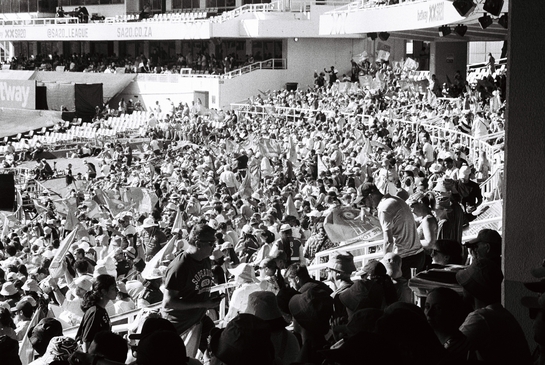
In my spare time I enjoy triathlon training, pretending that my problems don't exist, film photography, volunteering for SANParks, and making cocktails.
The majority of my undergrad and masters degrees were profoundly involved with student leadership, through house leadership and student societies.
If you want to know whether I want to create an AI that takes over the world, the answer is yes.
But I'll settle for one which makes a lot of money.

Personal information.
- Website: jeanpierrevanzyl.github.io
- Phone: You'll have to buy me a drink first
- Institution: Stellenbosch University
- City: Stellenbosch, RSA
- Occupation: Junior Lecturer, PhD candidate
- Degree: MSc
- Email: vanzylj -at- sun -dot- ac -dot- za
- Freelance: Available
Resume
Hereby a summary of my education and previous work experience.
Summary
Jean-Pierre van Zyl
Brief overview of experience
- Curriculum Vitae
- Currently hold MSc in Computer Science
- Work experience consists of multiple internships
- Multiple years spent serving on student leadership
Education
PhD in Computer Science (In progress)
2023 -
Stellenbosch University, Stellenbosch, RSA
- Currently studying under Professor A.P. Engelbrecht
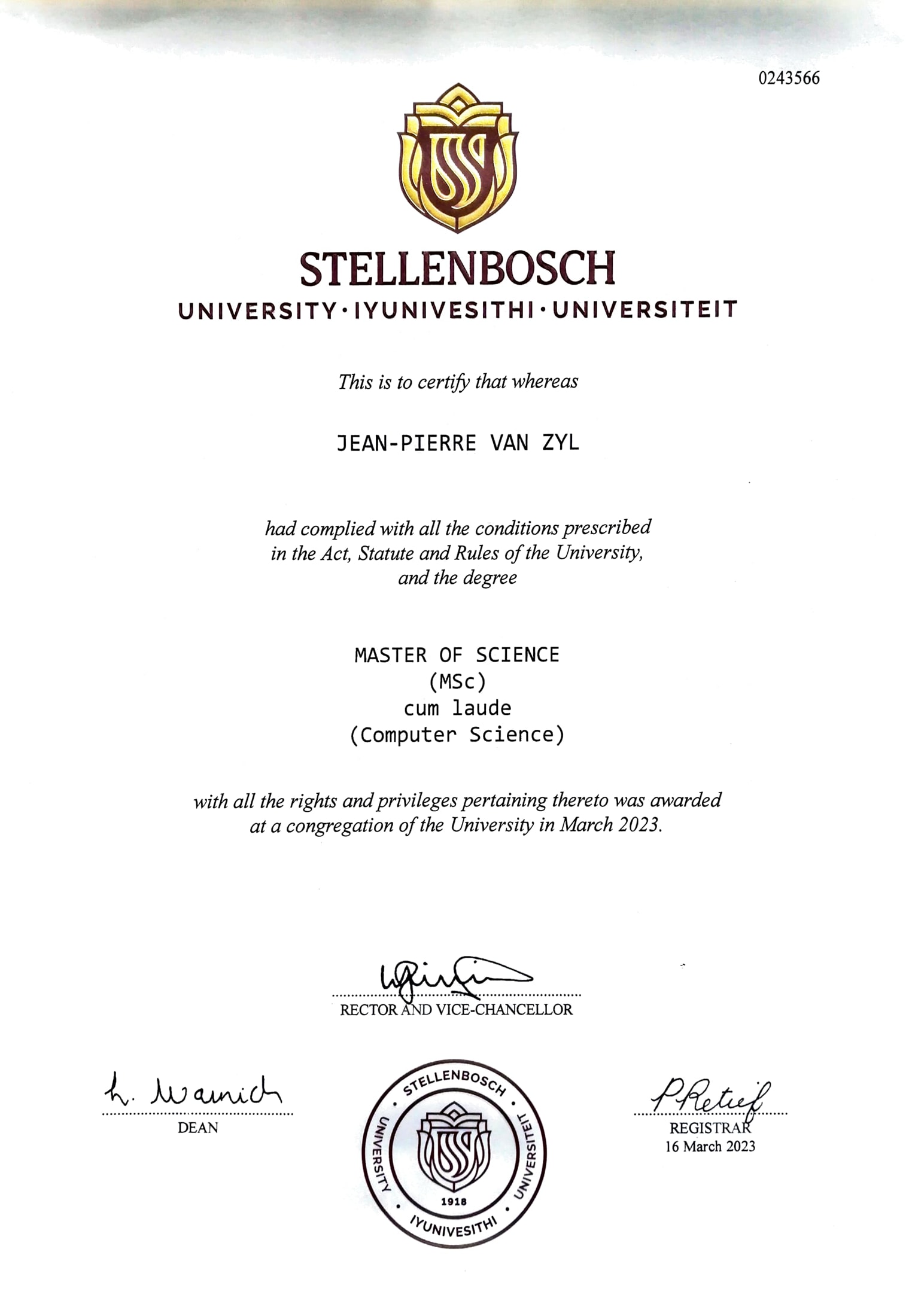
Master of Science in Computer Science (Cum Laude)
2021 - 2022
Stellenbosch University, Stellenbosch, RSA
- Obtained Cum Laude
-
View Degree
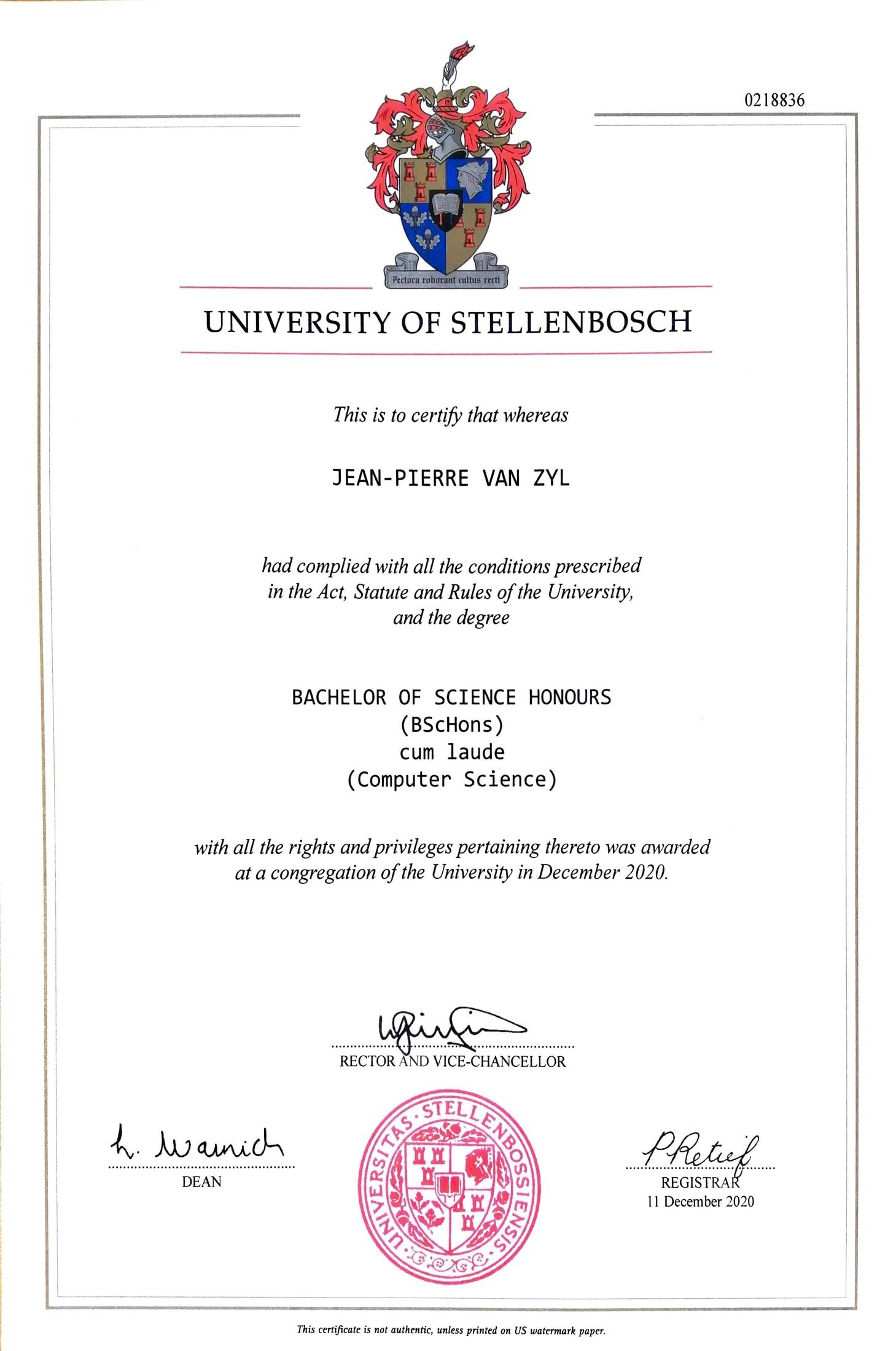
Bachelor of Science (Honours) in Computer Science (Cum Laude)
2020 - 2020
Stellenbosch University, Stellenbosch, RSA
- Obtained Cum Laude
-
View Degree
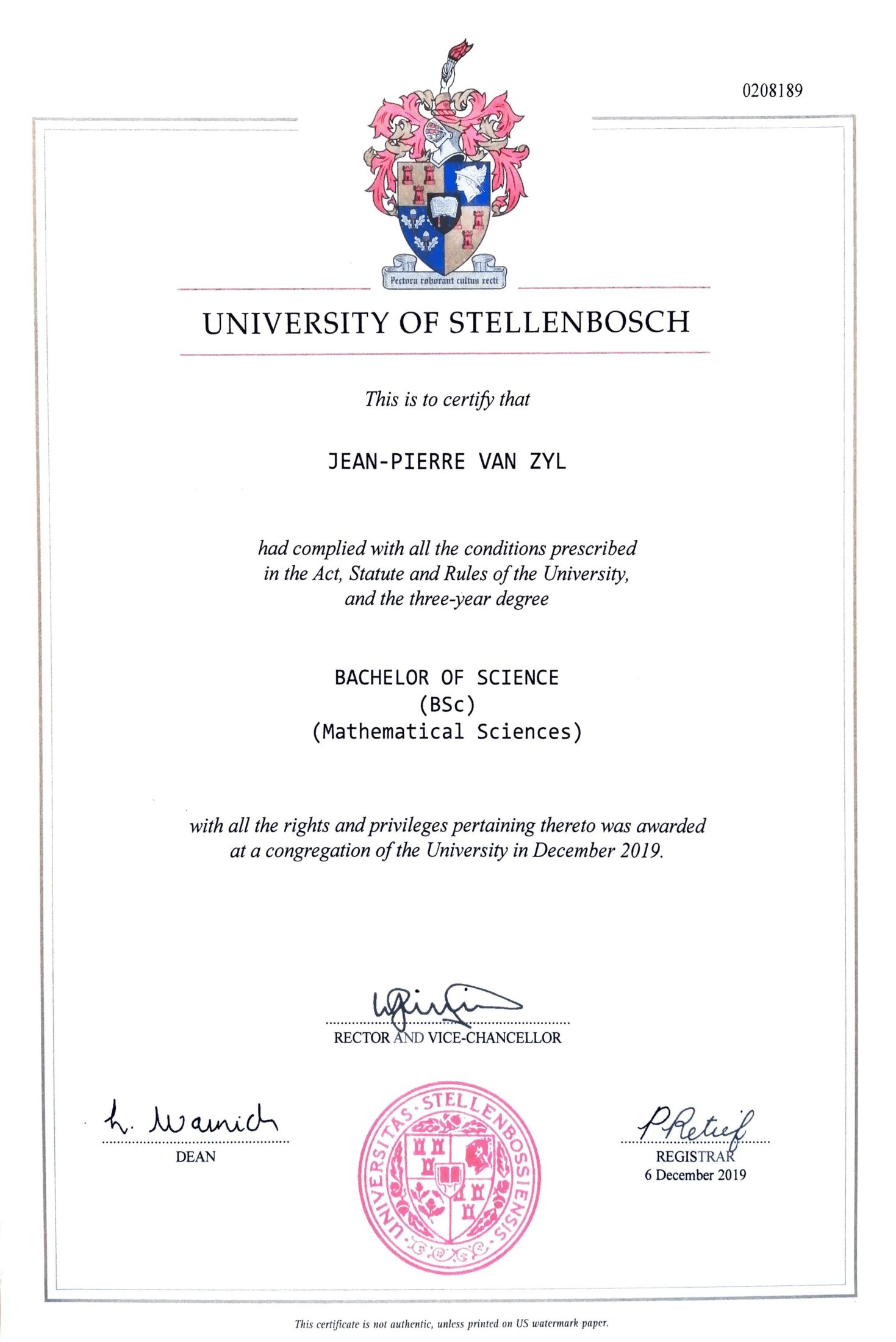
Bachelor of Science in Mathematical Sciences (Computer Science)
2017 - 2019
Stellenbosch University, Stellenbosch, RSA
- Completed a BSc in Mathematical Sciences with a main stream in Computer Science
-
View Degree
National Senior Certificate
2012 - 2016
Fairmont High School, Durbanville, RSA
- Obtained 6 distinctions
Professional Experience
Junior Lecturer, Part-time
2025 -
Stellenbosch University, Stellenbosch, RSA (www.ie.sun.ac.za)
- Lecturing and student supervision
Scholarship program
2023 - 2024
BMW IT Hub, Pretoria, RSA (www.bmwithub.co.za)
- PhD funded by BMW as a contractor for the IT Hub
Teaching Assistant, Part-time
2022 - 2024
Stellenbosch University, Stellenbosch, RSA (www.ie.sun.ac.za)
- Project marking and module admin
Intern, Part-time
Mar 2021 - Jun 2021
Merlynn Intelligence Technologies, Centurion, RSA (www.merlynn-ai.com)
- Merlynn is an artificial intelligence firm developing customized AI solutions, without the need for historical data.
- Worked remotely while studying my MSc, contributed to expanding the capabilities of their AI systems.
Intern, vac work
Jan 2021 - Feb 2021
Polymorph Systems, Stellenbosch, RSA (www.polymorph.co.za)
- Polymorph is a software solutions company with wide range of focus and experience across industries
- Worked as a part of the in-house R&D team which drove the expansion of the company's IoT work to include Computer Vision at the Edge
Intern, vac work
Nov 2020 - Dec 2020
NMRQL Research, Stellenbosch, RSA (nmrql.com)
- NRMQL is an AI-driven investment company using cutting-edge technology to disrupt the industry
- Position provided first introduction to the Fintech industry
- Contributed to the expansion of the set of tools used to trade securities
Research Experience
All this stuff is fake. How does one even judge an open-ended skill as a percentage? But I see all the kids are doing it.
Publications
Outlined are selected publications
Set-based particle swarm optimisation convergence
The shortcomings of the set-based particle swarm optimisation algorithm are outlined, and non-convergence is proved theoretically. Springer Swarm Intelligence.
Closed-Form Expressions for the Normalizing Constants of the Mallows Model and Weighted Mallows Model on Combinatorial Domains
This paper expands the Mallows model for use in combinatorial domains by deriving closed-form expressions for the normalizing constant of the distribution under various discrepancy functions, calculable in constant time. MDPI Mathematics.
Analysis of classification metric behaviour under class imbalance
This paper shows the unreliability of contemporary performance evaluation metrics for classification problems, and proposes a method to create robust metrics. Elsevier Egyptian Informatics Journal.
Set-Based Particle Swarm Optimisation: A Reivew
The main objective of this paper is to review the set-based particle swarm optimisation algorithm and to provide an overview of the problems to which the algorithm has been applied. MDPI Mathematics.
Rule Induction Using Set-Based Particle Swarm Optimisation
The SBPSO algorithm was successfully applied to induce rule sets on categorical data to allow for transparent classification for critical industries. This work has been published at the IEEE World Congress On Computational Intelligence (2022).
Polynomial Approximation Using Set-Based Particle Swarm Optimization
The SBPSO is an adaptation of the standard PSO for problems in a discrete search space. This algorithm was applied to solve regression problems and published for the International Conference on Swarm Intelligence (2021).
Student Supervision
A summary of past students supervised
Deep learning models, characterised by their multilayered complexity and vast parameter counts, have become the prevailing approach to image classification. Yet, the widespread adoption of deep architectures often occurs without critical assessment of whether such complexity is necessary. The study presented in this research assignment re-examines the assumption that deeper architectures are inherently superior. The investigation focuses on whether shallow neural networks, when supported by informed preprocessing, can achieve accuracy comparable to deep learning models while maintaining efficiency and interpretability. Three benchmark datasets of increasing complexity — MNIST, Fashion MNIST, and CIFAR-10 — are used to evaluate the hypothesis of the study. The study follows a structured, data-centric process which comprises exploratory data analysis, model-centric preprocessing, dataset-centric enhancement, and statistical validation. Class-specific preprocessing pipelines are developed to address residual misclassification, and incorporates handcrafted features such as edge, texture, and colour descriptors that reflect the visual attributes most relevant to each dataset. Across thirty independent runs, the optimised shallow networks achieve mean test accuraciesof 98.67% on MNIST, 88.16% on Fashion MNIST, and 78.44% on CIFAR-10. Performance on MNIST and Fashion MNIST match that of reported deep learning baselines, while the CIFAR-10 results demonstrate that shallow architectures remain viable for complex datasets when supported by targeted preprocessing, feature engineering, and ensembling. Statistical analyses confirm that improvements are significant and accompanied by reduction in required computational resources. The results challenge the presumption that depth is a prerequisite for high performance, and demonstrate instead that data-centric refinement can deliver competitive accuracy with substantially lower computational cost. The study contributes are producible framework for aligning model complexity with data characteristics, and advances the case for data-centric, efficiency-aware evaluation in modern image classification.
Andrea Mitchell
To Go Deep, Or Not To Go Deep
The research develops a particle swarm optimisation-based maximum-margin classifier that addresses the computational and theoretical limitations of quadratic programming used in training support vector machines. Conventional training in the primal or dual form requires strict convexity, satisfaction of the Karush-Kuhn-Tucker conditions, and clean, balanced data. In practice, real-world datasets often contain noise, class imbalance, and high dimensionality, which increase computational cost and reduce the reliability of quadratic program-ming solvers. To reduce computational effort and focus optimisation on informative samples, the procedure is restricted to Tomek link pairs located near class boundaries. The removal of redundant and non-support vectors lowers the effective problem dimensionality and improves margin estimation, which yields more stable and generalisable decision boundaries. The framework is extended to non-linear classification through kernel functions, such as radial basis function and polynomial kernels, which implicitly map data into higher-dimensional feature spaces to model complex decision surfaces under class overlap and noise. Experiments on seven benchmark datasets and four synthetic datasets show that the proposed classifier achieves classification accuracy and F1 scores comparable to, or exceeding, those of support vector ma-chines trained using quadratic programming. Although the method requires greater computational resources due to iterative fitness evaluations, it provides a flexible, solver-free alternative that avoids assumptions of convexity, differentiability, and dual formulation.
Sizalobuhle Ncube
A particle swarm optimisation-based Maximum-Margin Classifier


Unrelated
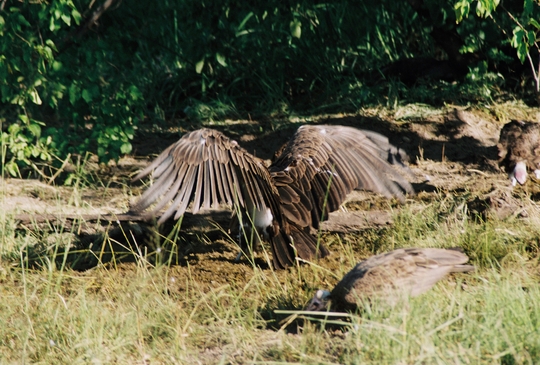
Some film works. Why not.
- All

























Contact
Feel free to contact me about any freelance work, academic consultations or general queries
Location:
Media Lab, Engineering Faculty, Stellenbosch University, Stellenbosch 7600
Email:
vanzylj -at- sun -dot- ac -dot- za
Call:
Still waiting on that drink